Hope 4 Hurting Kids - Moving from hurt and trauma to Hope and Healing.
  • Home
  • COVID-19
  • Explore
    • Emotions
    • Family
    • Trauma
    • Other
  • Help Centers
    • Emotions Help Centers
      • Emotions General
      • Grief
    • Family Issues Help Centers
      • Divorce and Modern Family
      • Domestic Violence
      • Family Issues
      • Foster Families
    • Trauma Help Centers
      • Child Abuse & Neglect
      • Domestic Violence
      • Sexual Abuse and Rape
    • Destructive Behaviors Help Centers
      • Bullying
      • Cutting and Self-Harm
      • Eating Disorders
      • Substance Abuse
      • Suicide
  • Get Help
    • Contact Us / Get Help
    • H4HK FAQs
    • Hotlines
  • More…
    • About Us
    • Surveys
      • Children of Divorced/Separated Parents
Hope 4 Hurting Kids - Moving from hurt and trauma to Hope and Healing.
Home
COVID-19
Explore
    Emotions
    Family
    Trauma
    Other
Help Centers
    Emotions Help Centers
    Emotions General
    Grief
    Family Issues Help Centers
    Divorce and Modern Family
    Domestic Violence
    Family Issues
    Foster Families
    Trauma Help Centers
    Child Abuse & Neglect
    Domestic Violence
    Sexual Abuse and Rape
    Destructive Behaviors Help Centers
    Bullying
    Cutting and Self-Harm
    Eating Disorders
    Substance Abuse
    Suicide
Get Help
    Contact Us / Get Help
    H4HK FAQs
    Hotlines
More...
    About Us
    Surveys
    Children of Divorced/Separated Parents
  • Home
  • COVID-19
  • Explore
    • Emotions
    • Family
    • Trauma
    • Other
  • Help Centers
    • Emotions Help Centers
      • Emotions General
      • Grief
    • Family Issues Help Centers
      • Divorce and Modern Family
      • Domestic Violence
      • Family Issues
      • Foster Families
    • Trauma Help Centers
      • Child Abuse & Neglect
      • Domestic Violence
      • Sexual Abuse and Rape
    • Destructive Behaviors Help Centers
      • Bullying
      • Cutting and Self-Harm
      • Eating Disorders
      • Substance Abuse
      • Suicide
  • Get Help
    • Contact Us / Get Help
    • H4HK FAQs
    • Hotlines
  • More…
    • About Us
    • Surveys
      • Children of Divorced/Separated Parents
Coping Skills

Triangle Breathing

triangle breathingLast week we looked at an easy way to help kids learn deep breathing called Lazy 8 Breathing. Triangle breathing is another simple way to teach kids how to breathe as a means of coping. The triangle breathing method adds the additional step of holding in the breath before exhaling as explained further below. like Lazy 8 Breathing, you can find a triangle in a picture or simply have the child make a triangle on a piece of paper.

How Does Triangle Breathing Work

Have the child trace the triangle with their finger. The speed will vary depending on the size of the triangle, but try to have the child trace it in such a way that tracing each side takes about 3-4 seconds. It might help to count out loud as the child begins the exercise in order to help them get into a rhythm. As the child traces the first side of the triangle, they should breath in deeply through their nose. As they trace the second side, they should hold the breath in. As they trace the final side, have them breathe out slowly through their mouth. Together Lazy 8 Breathing  and Triangle Breathing serve as a great introduction to breathing as a coping skill in the Please Don’t Sweat The Small Stuff coping skills toolbox.

Continue reading

April 6, 2018by Wayne Stocks
Coping Skills

Pool Noodle Fidget Toys

Pool Noodle Stress RelieversPool Noodle Fidget Toys are an easy DIY project you can make for, or with, your kids. They are cheaper than fidget spinners, squishies and other fidget toys, and you can mass produce them with relative ease. I’ve worked with kids for years, and for many of those years I was in charge of games with a large group of students. Ever since that time, I’ve kept a box of pool noodles in my basement, because you never know when you’re going to need them! (FYI, you can get a box fairly cheap after summer is over). A standard pool noodle can be used to create 42 fidget toys. Here’s all you need to know:

63 inches – 42 stress relievers

Items Need For Project

  • Pool Noodles
  • Scissors or a Knife
  • Ruler
  • Pencil

Continue reading

April 5, 2018by Wayne Stocks
Coping Skills

Lazy 8 Breathing

Lazy 8 BreathingLazy 8 Breathing is a very simple technique to help teach kids deep breathing. Deep breathing is a foundational skill when it comes to coping and is a vital part in the Please Don’t Sweat The Small Stuff coping tool box. Whether you find the number 8 in a magazine or book or draw your own on a sheet paper, you can quickly and easily teach kids a simple method to practice deep breathing.

How Does Lazy 8 Breathing Work

Have the child trace the number 8 with their finger. Obviously, the speed will vary depending on the size of the 8, but try to have the child trace the eight in such a way that tracing each side of the eight takes about 3-4 seconds. As the child traces one side of the 8, they should breath in deeply through their nose. As they cross the intersection line and trace the other side, have them breathe out through their mouth. That’s it! We told you it was easy, but it is a simple and effective way for kids of all ages to remember how to breathe deeply in order to cope with difficult circumstances.

Continue reading

March 30, 2018by Wayne Stocks
Coping Skills, Divorce and Family Disruption

H4HK FAQs: Am I The Only One Going Through This?

Am I The Only One

H4HK FAQs are designed to answer questions kids and teens ask when facing difficult situations and circumstances in their lives.

Divorce is hard, and as a child divorce you may wonder if anyone else understands what you are going through.  Well, the answer is yes…and….no!

Unfortunately, lots of kids each year experience the divorce of their parents.  In fact, since 1972 roughly one million kids per year, or more, have seen their parents divorce (sometimes more than once).  Forty percent of children under the age of 18 do not live with their married biological (or adoptive) mom and dad (that’s 2 out of every five people under the age of 18).

So, the answer to the question, “Am I the only one going through this?” is no.  There are lots of other kids who are also experiencing the divorce of their parents each year.  Chances are you have cousins or friends or neighbors or schoolmates whose parents are divorced.  Plus, the divorce rate (that is the number of people getting divorced) has been high for years.  That means there are also tons of adults out there who went through the divorce of their parents when they are kids.  Many of these adults can relate to what you are going through, and have the experience to help you in your own journey.

So, there are lots of other people who know what it is like when parents divorce.  But, only you understand what it is like for YOUR parents to get divorced.  While other people may understand what it’s like to have divorced parents, only you live in your skin each day and know what is going on in your mind and in your heart.  Find a trusted adult or friend to talk to about those thoughts and feelings.  Keeping all of that inside doesn’t help you or your parents or anyone else.  Just because there are a lots of children of divorce doesn’t mean that anyone knows exactly what you are going through unless you tell them!

Continue reading

December 29, 2017by Wayne Stocks
Coping Skills

Burying the Box

Burying the Box

Not all coping mechanisms are positive. Today I’d like to discuss a negative coping mechanism often used by kids in dealing with negative emotions.

What is Burying the Box?

Children and adults often use a wide range of coping mechanisms to deal with difficult situations. One such coping mechanisms that kids often employ is known as “Burying the Box” of feelings. Burying the Box is all about disguising the impacts of difficult emotions by putting on a “happy face” and an air of confidence to the outside world.

Just because someone has a smile on their face and seems to be fine doesn’t mean that’s actually the case. As discussed in my last article, children generally have little control over their own surroundings. This results in them using coping mechanisms that aren’t always particularly healthy. I often see it in clients (especially those aged 13-18) who will laugh off their experiences as if they don’t matter and have discernible impact on them.

Underneath the confidence though is a young person putting up their guard and not allowing anyone to come too close. They build these false walls telling people telling people “I’m fine” or “My day was ok thanks” rather than dealing with the underlying emotions. You will soon realise these statements come with little detail or support. A kid who is Burying the Box will appear as though they are soaring with confidence to their peers while totally shutting off the people who know what they have been through. This is because they want to minimize the risk of having to talk about their actual feelings. Continue reading

October 19, 2017by Kay Westwood
Coping Skills

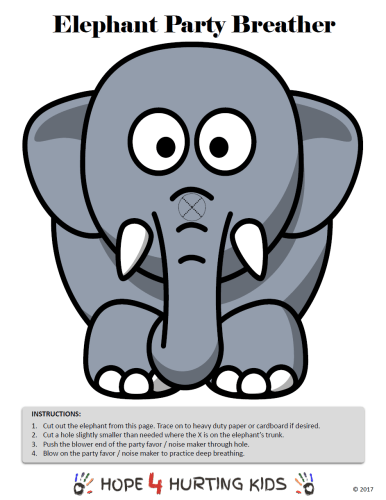
Elephant Party Breather

Elephant Noise Maker

The Elephant Noise Maker is a fun and useful tool for teaching kids deep breathing techniques. Deep breathing is a key coping skill and one of the Soothing Coping Skills covered in Please Don’t Sweat The Small Stuff.

Elephant Noise Maker Side ViewElephant Noise Maker Front ViewIn the past we have drawn a picture of an elephant on a piece of heavy paper or cardboard to create our elephant noise makers. With this new template you can either use the picture to trace on something more durable or simply cut the elephant out and use the template itself.

Here’s are the instructions:

1.Cut out the elephant from the template. Either trace the elephant on to heavy duty paper or cardboard if desired or use the elephant from the template.

Continue reading

October 12, 2017by Wayne Stocks
Coping Skills, Grief

The Shield of Strength

Shield of StrengthGrief and worry can often leave young people feeling all alone and isolated. The Shield of Strength is a fun craft and activity to get kids thinking about their own assets and other people in their lives that can be there to help them when they need it the most. You can click on the picture above to get a downloadable template for the Shield of Strength as well as the instructions.

Here’s how it works:

  1. Draw a shield pattern like the one above on a large piece of cardboard or poster board.
  2. Divide the shield into four sections by drawing a horizontal and vertical line.
  3. Label the four quadrants as “Family,” “Friends,” “Skills” and “Others.”
  4. Cut the shield out.
  5. Write people or skills/abilities in each section that can help to protect you or help you feel better when you’re feeling down.
  6. Keep the shield as a reminder that you are never alone in the struggles and difficulties that you face.
  7. Instead of making a large shield, you can use the template on the following page to create a smaller version.

Continue reading

September 28, 2017by Wayne Stocks
Coping Skills, Emotions, Overcoming Emotions, Understanding Emotions

Jump In! Stand Strong! Rise Up! (A Comprehensive Emotions Management Plan)

Jump In, Stand Strong, Rise Up

Children and teens live in an ever-changing world that throws more and more at them and prepares them less and less to deal with the direct impacts, the collateral damage and the emotions that follow. At Hope 4 Hurting Kids, our goal is to help these hurting children and teens move from hurt to hope and healing.

Today we announce a three stage plan to help young people understand, deal with and overcome the difficult emotional circumstances of their lives. We’re calling it:

JUMP In! STAND Strong! RISE Up!

We contemplated other names for this strategy like “Recognize, Survive and Thrive” and “Know It, Own It and Grow From It”; but in the end we settled on “Jump In! Stand Strong! Rise Up!” as a visual picture of the three stages of dealing with difficult and unpleasant emotions. Let’s have a closer look at each stage. Continue reading

July 27, 2017by Wayne Stocks
Coping Skills, Emotions

Please Don’t Sweat The Small Stuff (Coping Skills)

Please Don't Sweat The Small Stuff

The first step in helping kids (or anyone for that matter) to deal with and process the difficult emotions in their lives is to help them understand and name emotions. At Hope 4 Hurting Kids, we use the Super Simple Feelings Management Technique for that. Once we have helped kids to understand their emotions, we need to provide them with means for dealing with those emotions.

The second step towards emotional maturity and healing is to develop a robust set of coping skills. Coping Skills are designed to help “take the edge” of emotions and assist us in dealing with them. Unfortunately, that moment when a young person is drowning in emotions is not the right time to start thinking about coping mechanisms. Instead, it is important that kids and teens have at their disposal a tool box full of coping mechanisms that work for them that they can draw from in a time of crisis.

At Hope 4 Hurting Kids, we’ve developed another mnemonic to help keep track of the many different types of coping mechanism. This time we borrowed from the title of a popular book series by Richard Carlson. The different types of coping skills can be readily recalled by remembering the phrase:

Please Don’t Sweat The Small Stuff

Continue reading

July 25, 2017by Wayne Stocks
Coping Skills

Using A Scream Box to Alleviate Anger, Fear and Stress

Scream BoxA Scream Box is a fun and effective way to vent some of those intense emotions that build up inside like anger, fear and stress. While breathing, physical activity and talking about it are great ways to help deal difficult emotions, sometimes you just need to scream! Handled correctly, this can be a therapeutic way to vent some of that frustration. Screaming however is not always socially acceptable or appropriate. That’s where the Scream Box comes in handy.

The pictures in this article are of a scream box my 13 year-old daughter made.

You can decorate your box however you want, but here are the basic steps:

1. Gather up the following ingredients:
– Cereal box (preferably an empty one).
– Cardboard tube from inside a roll of paper towels.
– Old newspaper or packing paper (regular paper or tissue paper can also work)
– Tape (duct tape works best, but packing tape will also suffice)
– Construction paper or wrapping paper to cover the cereal box
– Items to decorate your box (markers, pencils, stickers, glitter or whatever you want to use)

Continue reading

May 18, 2017by Wayne Stocks
Page 2 of 3«123»

“Helping young people on the journey from hurt and trauma to hope and healing.”

To contact us for any reason, please use our Get Help page. We promise to get back to you as soon as we can.
© 2018 Hope 4 Hurting Kids


Loading Comments...